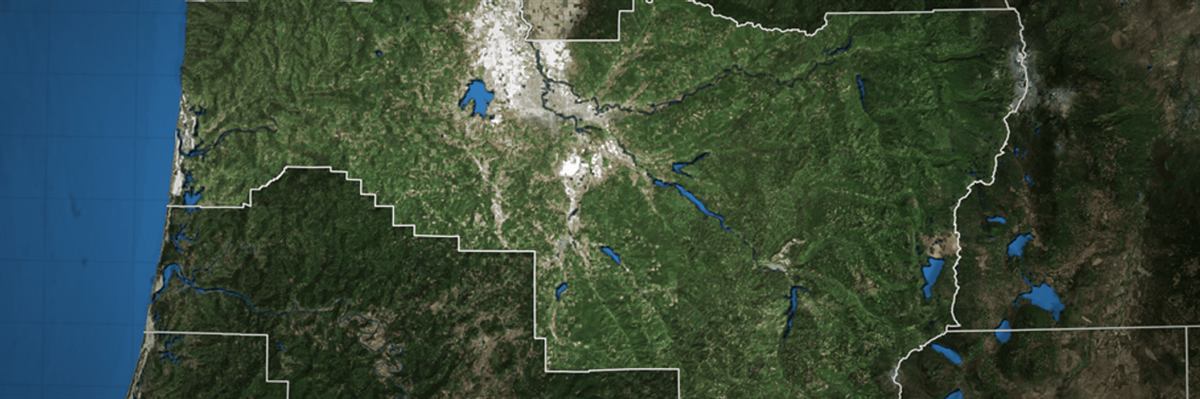

If you have gone looking for Oregon's wildfire hazard map and could not find it, that is not your search skills. The map no longer exists. The Legislature repealed it in 2025, and most of what is still written online about it — including advice telling you to look your address up on it — is out of date.
What Happened to Oregon's Wildfire Hazard Map?
It was repealed. Senate Bill 83, Chapter 590, passed in the 2025 session under the title "Relating to wildfire; and declaring an emergency." It was signed, carried an emergency clause, and took effect on passage. Among other things, it voids the State Forestry Department orders that had assigned property to wildfire hazard zones.
The map had a short and contested life. It came out of Senate Bill 762 in 2021, went through two rounds of revision and public comment, was finally published in January 2025 — and was repealed in the same year.
That history is why so much of the writing about it is wrong. Articles published between 2021 and early 2025 describe a map that was still coming or had just arrived. They were accurate when written. They are not now.
What Replaced It
The approach shifted from one statewide map with requirements attached to it, toward standards that local governments can adopt.
SB 83 eliminated certain building code standards and mapping requirements for wildfire hazard mitigation. In their place it directed the State Fire Marshal to develop a model code for defensible space, and directed the Department of Consumer and Business Services to adopt wildfire hazard mitigation code standards and make them available for local adoption.
The practical consequence for a buyer is simple: there is no longer a single state designation that tells you what a property is. What applies to a given parcel depends on where it sits and what that jurisdiction has adopted — so the question moves from "what does the map say" to "what is actually true of this property."
What to Check on a Rural Property Instead
The Oregon State Fire Marshal's defensible space guidance is still the best plain-language starting point, and the research behind it is unambiguous about where attention pays off most.
The zone that matters more than any other is the first five feet around the structure. Work by the Insurance Institute for Business & Home Safety found that reducing combustible material in that 0-to-5-foot band significantly lowers the chance of a house igniting from wind-blown embers — swapping bark mulch for gravel or pavers against the foundation, and moving furniture, cushions, bins and doormats back from the walls.
After that, it is the building itself. Home hardening means materials and details that resist ignition: siding and roofing that do not catch easily, windows that hold up to heat, and vents that keep embers out. Covering attic and crawlspace vents with eighth-inch metal mesh is one of the cheapest meaningful changes there is.
None of this needs a map to be worth doing, which is rather the point. When you walk a rural property, you are looking at the same things whether or not the state has a designation for it:
- What is within five feet of the house, and whether any of it burns
- Roof condition and material, and whether vents are screened
- Siding material, and the state of gutters and eaves
- How the driveway reads for a fire engine — width, surface, turnaround
Ask About Insurance Before You Are Under Contract
For most rural buyers this is the part that actually bites, and it is easy to leave too late.
Oregon has an insurer of last resort, the Oregon FAIR Plan, for property owners who cannot get covered in the standard market. To qualify you must have been declined by two standard insurance companies. Every FAIR Plan policy covers wildfire damage, but premiums are often higher than the standard market and the coverage is less comprehensive.
That is a workable backstop, not a plan A. The useful habit is to call an insurance agent with a specific address early — while you still have room to walk — rather than discovering the cost of coverage a week before closing. An insurer's appetite for a particular property is real information about that property, and it is information you can get for the price of a phone call.
If you are weighing rural acreage around Lane County and want a second pair of eyes on what you are looking at, that is the kind of thing we do every week. You can also browse homes for sale across Lane County to see what is currently on the market.
Common questions
- Does Oregon Still Have a Statewide Wildfire Hazard Map?
- No. Senate Bill 83, passed in 2025, voided the State Forestry Department orders that had assigned property to wildfire hazard zones. There is no statewide map to look your address up on.
- What Replaced the Wildfire Hazard Map?
- Standards rather than a map. SB 83 directed the State Fire Marshal to develop a model code for defensible space, and directed the Department of Consumer and Business Services to adopt wildfire hazard mitigation code standards, which local governments may choose to adopt.
- Does Defensible Space Still Matter If There Is No Map?
- Yes. The physics did not change with the statute. The Oregon State Fire Marshal still publishes defensible space guidance, and the first five feet around a house is the zone that matters most.
- What Should I Look At Instead of a Map?
- The property itself — the five feet closest to the house, the roof and vents, and the siding — plus a conversation with an insurance agent before you are under contract.